A bag policy is only as good as where the bags go
A bag policy with no named storage spot does not remove the bag: it moves it to the search lane or the lost property desk. Storage belongs on the site plan.

A bag policy that names what guests cannot bring but not where the bag goes has not solved anything. It has just decided, without meaning to, where the problem shows up: the search lane, the perimeter fence, or the lost property desk at the end of the night. For an organiser, that is a crowd flow and enforcement question, not a guest amenity to bolt on later.
What actually happens to a bag your policy does not allow
Write "no large bags" into your entry policy and every oversized bag that turns up at the gate becomes one of three things. It gets refused, and the guest who travelled for the show is now arguing with security instead of moving through the gate. It gets searched, which is the right call for safety but adds a manual step at every lane, every time. Or it gets taken off the guest entirely and handed to whoever is running lost property, who now has to store it somewhere for the rest of the event and try to reunite it with its owner afterwards.
None of those three outcomes removes the bag from your site. They just move who is holding it, and the third one turns your lost property tent into an unplanned storage room with none of the structure a storage room needs.
Copenhell already writes the destination into the policy
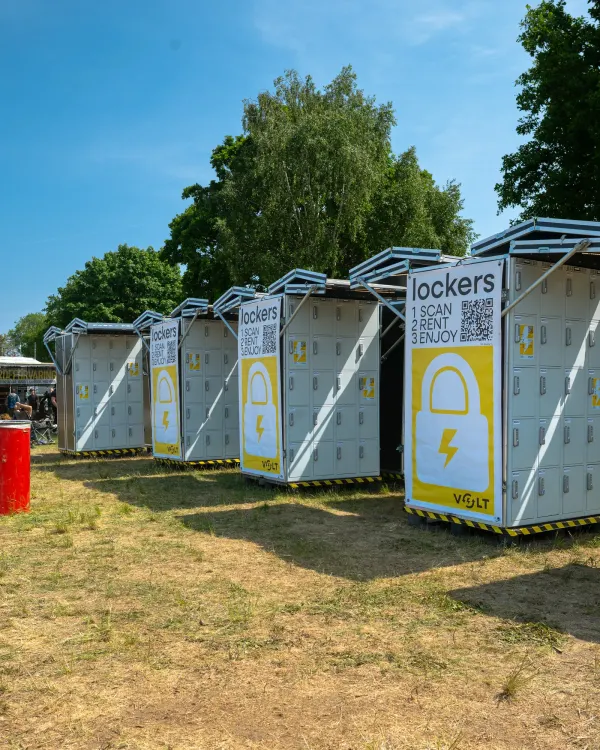
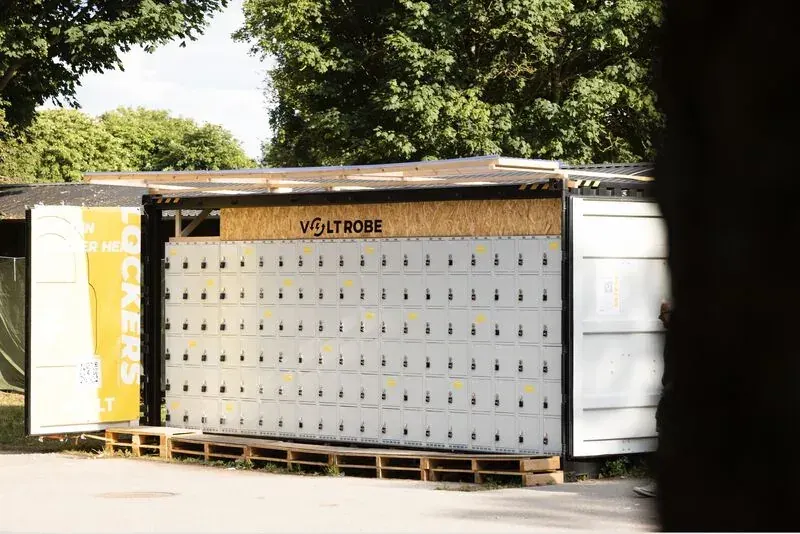
Copenhell's own entry rules make the point better than any amenity brochure could. Its TASKER section on copenhell.dk/praktisk-information reads: "Du må gerne tage en lille rygsæk, der ikke er større end din ryg, med ind på festivalpladsen. Alle større tasker skal lægges i et af Volts garderobeskabe." In English: a small backpack, no bigger than your own back, is fine to bring in. Every larger bag has to go in one of Volt's garderobeskabe, literally "wardrobe cabinets", which is Copenhell's own word for what Volt sells publicly as Event Lockers.
Notice what the sentence structure does. The bag rule and the storage instruction are the same policy line, not two separate documents that a guest has to connect themselves. A festival goer reading the rule is told the limit and where to solve it in the same breath. That is what makes the rule enforceable at the gate: staff are not asking someone to leave a bag with no answer for where it goes, they are pointing at a named place.
Why this is a scale problem, not a courtesy
Roskilde runs five named entrances for a festival that roskilde-festival.dk puts at over 130,000 festival goers. A bag policy with no sanctioned destination does not fail once at that scale, it fails five times simultaneously, at every gate, for as long as the gates are open. Multiply "sort it out yourself" by five entrances and thousands of guests an hour and the gap in the policy stops being an edge case and becomes the default outcome for a meaningful share of arrivals.
The lost property tail shows what that looks like once the event is over. A single van-load handed to Central and West Zealand Police after a recent Roskilde Festival held roughly 200 forgotten phones and around 50 bunches of keys, on top of jewellery and power banks. That is not a theft number and it is not an incident count, it is just personal items that ended up unmanaged rather than in a place the guest chose and could get back to during the event. A named locker with an access code is a different outcome for the same object than a box at a police station days later.
The market already argues this in entry and exit language, not amenity language
This is also how the locker trade itself pitches storage to organisers, once you strip the marketing gloss off it. Vendors in this space write directly about bottlenecks, wayfinding, and ingress and egress at gates, and about the site's flow being safer for it, because that is the actual sales argument for a buyer running security and crowd flow, not a buyer picking guest perks. The framing lines up with what Copenhell's own policy already shows in practice: storage sits next to the gate rule because it is part of how the gate works, not something offered once the guest is already inside.
Volt's own Nordic festival bag rules piece lays out roughly a dozen festivals' published entry policies side by side. Read across them and the pattern holds: every festival that enforces a bag limit either names a storage location in the same policy or leaves guests to work it out themselves at the gate, and the second version is the one that produces queues, disputes and a fuller lost property tent.
Put it on the site plan, not the amenity list
If you are drafting or reviewing a bag policy for next season, the decision that matters is not "do we allow storage as a perk." It is "where does a refused or searched bag actually go, and is that place decided before the policy is published." That belongs in the same planning conversation as your search lanes and entrance layout, with production and security in the room, not added afterwards as a guest-facing extra.
This is deliberately not a sizing question. If you already know you want lockers and need to work out how many, how many Event Lockers your festival needs covers that. This piece is the step before it: deciding that storage belongs on the site plan at all, and writing the destination into the policy the way Copenhell does, rather than treating it as something guests will figure out on the day. Where each locker bank should then sit relative to the gate, the search and the exit route is worked through in Event Locker placement: ingress, egress and bottlenecks.
Talk to Volt's team about where storage fits on your entry plan at /for-organisers/, or see how Event Lockers work as a service. Direct questions go to hello@getvolt.dk.
FAQ
What happens to a bag a festival does not allow in?
One of three things: it is refused at the gate, it is searched and returned, or it is taken from the guest and held at lost property for the rest of the event. None of these removes the bag from the site, they just decide who ends up storing it and how organised that storage is.
Does Copenhell require guests to use lockers for bags?
Yes, for anything larger than a small backpack. Copenhell's own entry policy states that larger bags must go in one of Volt's garderobeskabe, its own term for the on-site Event Lockers, in the same sentence as the size limit itself.
Why treat bag storage as a crowd flow decision instead of a guest amenity?
Because an unsanctioned bag does not disappear when a policy bans it. It becomes extra handling at the search lane, a dispute at the gate, or an item sitting at lost property, all of which slow entry and create work for staff who are trying to move people through, not store their belongings.
How many entrances does Roskilde Festival have, and why does that matter here?
Five named entrances, for a festival that runs to more than 130,000 festival goers. A bag policy without a stated storage destination does not fail at one gate, it fails at all five, at the same time, for every hour the gates are open.