Charging at events: build your own solution or bring in an operator?
Should your festival run phone charging in-house or hire an operator? This guide covers the real costs, staffing trade-offs and when the operator model wins.

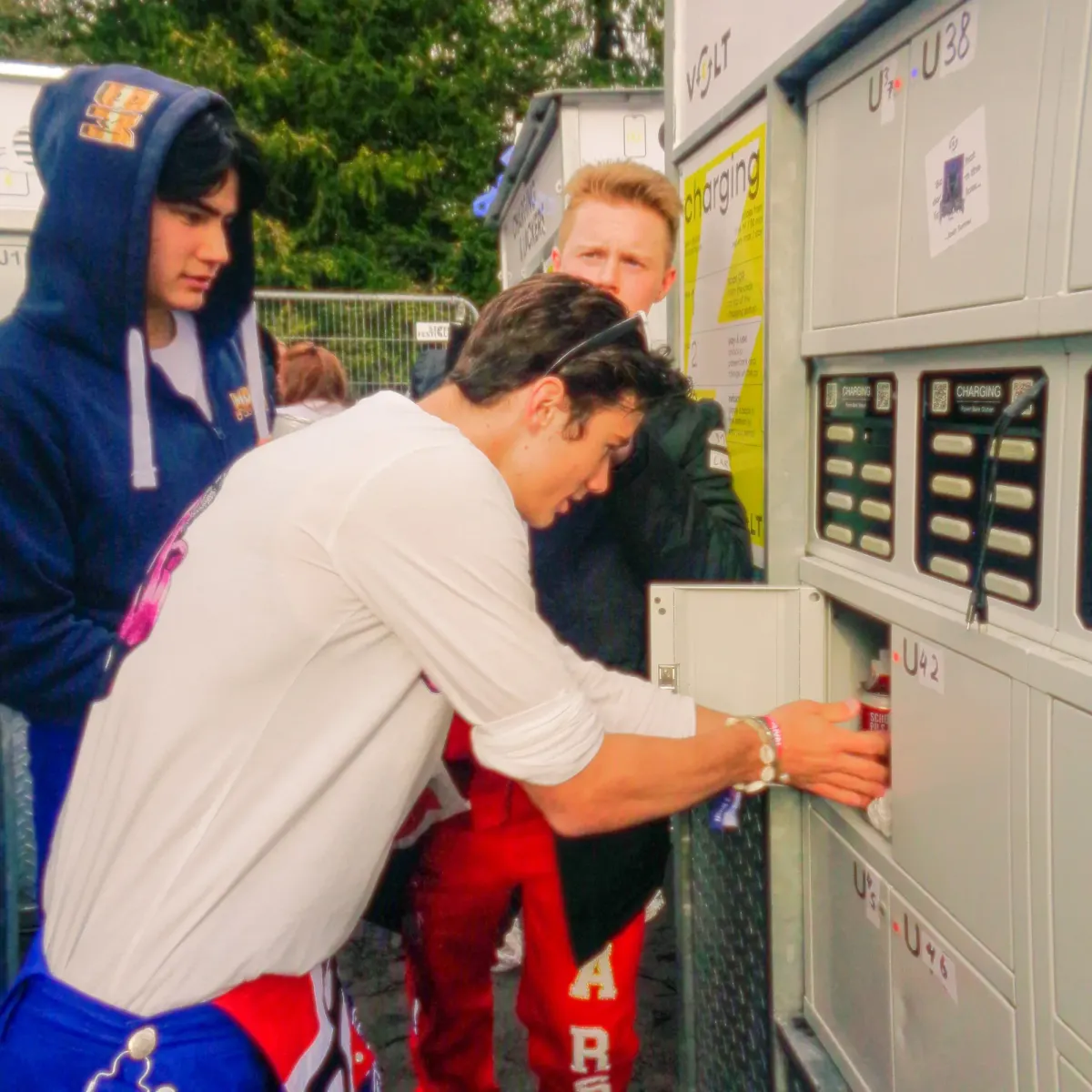
Every festival organiser hits the same fork: buy charging hardware and run it in-house, or hand the whole thing to an operator and take a revenue share. The hardware cost looks manageable on a spreadsheet, right up until staffing, maintenance windows and the queue you will personally own if a unit fails at peak time on Saturday night get added in. The honest answer depends on scale, how often you run events and what your team actually has bandwidth for. This article walks through the decision.
What "build your own" actually involves
Building a charging solution from scratch means buying or leasing the hardware, writing the operational procedures, hiring and training booth staff, managing the cash or payment flow, handling deposits and returns, and arranging storage, transport and maintenance between events. For a one-off or experimental year, that is a lot of moving parts to own.
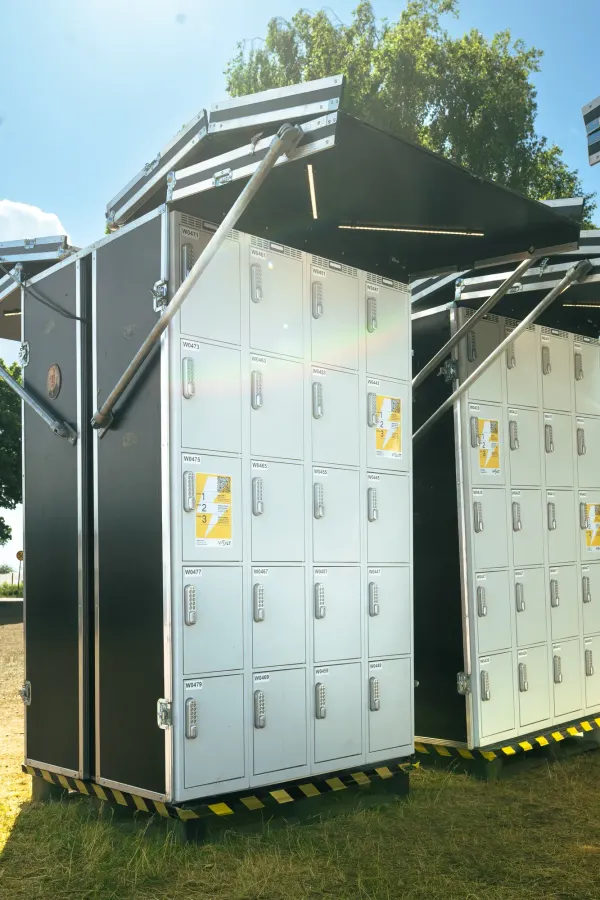
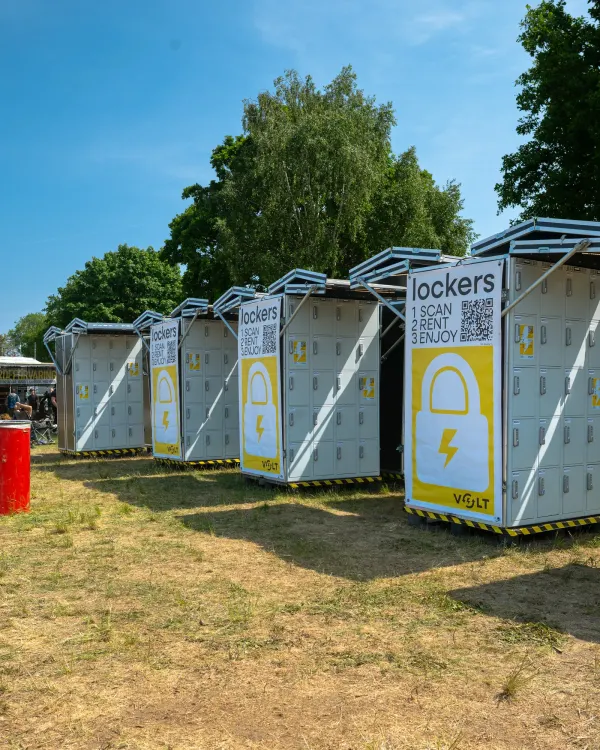
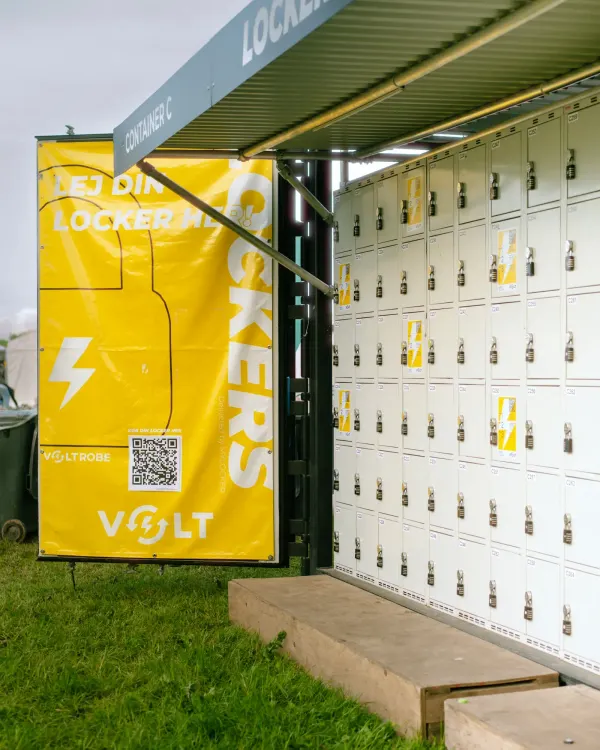
Hardware alone covers a wide range. Lockers with built-in USB ports, over-the-counter powerbank-dispensing units and free-standing self-service stations all have different power requirements, footprint and failure modes. None of them are plug-and-play. Each one needs a site plan, a power draw calculation, a cable management approach and someone on-site who knows what to do when a unit stops responding mid-afternoon on day two.
There is also a maintenance window to plan for that a spreadsheet rarely accounts for. Between events, units need cleaning, cable and connector checks, firmware updates and battery health checks before they go back out. On a multi-day festival, that window shrinks to overnight, which means someone has to be scheduled to do it after the last shift ends and before the gates open the next morning. Skip it and the failures show up exactly when the site is busiest.
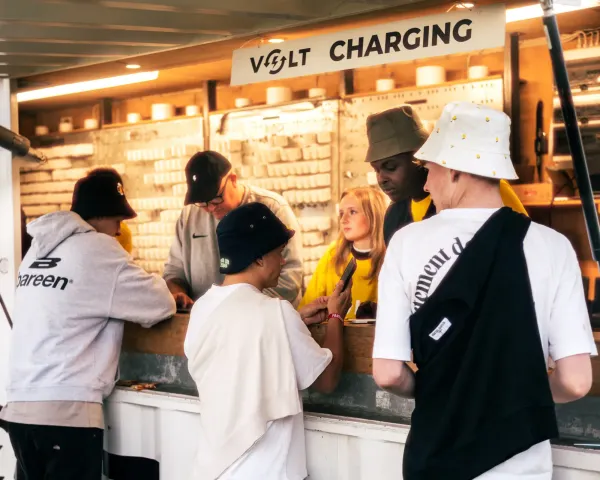
Then there is the staffing question. A Volt Charging Service booth at a mid-size festival typically runs with two to four people per shift across three days. That is real scheduling, real payroll, real training time. Event staffing platforms in Europe put general event staff costs in the range of EUR 15 to 25 per hour before coordination and supervision, so a staffed charging point running 14-hour days over a three-day festival can easily add up to EUR 2,500 to 6,000 in labour alone before equipment is factored in (general staffing cost data from TempGuru's event staffing cost guide).
That is not automatically prohibitive, but it is a cost centre your team has to carry. If your organisation runs 10 or more events per year with charging as a standard feature, owning the hardware and building the ops muscle starts to make financial sense. For most organisers, it does not.
What an operator brings that is hard to replicate internally
A specialist charging operator brings three things that are difficult to build quickly: proven hardware at scale, trained staff who know the product, and the data and logistics systems behind the operation.
Volume matters more than it appears. The self-service charging stations Volt deploys at festivals are purpose-built units with multiple cables, real-time capacity monitoring and swap logic tuned to festival crowd behaviour across over 120 events per year in Europe. That iteration history is baked into the product and the operating procedure. A first-time organiser building in-house does not have that, and it shows in the queue lengths and festival goer experience.
Operators also absorb the risk of equipment failure, theft and deposit disputes. If a powerbank goes missing, that is a cost the operator tracks and manages. If a station breaks down, the operator's field team handles it, including the overnight maintenance window above. That risk transfer has real value, especially for smaller teams where a charging problem at peak time on Saturday night could consume the whole ops team for an hour, on the one night nobody has spare hands.
On the financial side, the operator model often shifts charging from a cost centre to a revenue line. A revenue-share arrangement means the operator brings all equipment, staffs the operation and splits the festival goer fees with the festival. The festival takes no upfront hardware or staffing risk and receives a share of each transaction. For organisers who want to offer the service without capital exposure, that structure is hard to beat.
How to frame the scale question
Two variables drive the decision more than anything else: how many events you run per year and what your expected peak demand looks like.
If you run one or two events per year, the economics of ownership rarely stack up. A self-service charging station unit costs several thousand euros to buy outright, needs maintenance contracts, insurance and storage for 50 weeks of the year, and still requires trained staff when it is deployed. Hiring an operator for those two events is almost certainly cheaper on a fully-loaded cost basis.
If you run eight or more events per season, hardware ownership starts to pencil out, but the staffing and logistics overhead does not go away. The question becomes whether your team has the bandwidth and the appetite to run a specialist operation alongside everything else on the event site. Most festival ops teams say no, not because they lack the skills but because charging is not their core focus, and specialist operators will always be more efficient at it.
Peak demand is the other lever. A self-service charging station can handle roughly 150 to 250 rentals per day at steady throughput (see Juuce's charging station capacity analysis). At a 30,000-person event where 15 to 20 percent of festival goers want to charge at some point across the day, you need multiple units and enough redundancy that a single machine failure does not create a queue that circles the whole concourse. Sizing that correctly from scratch, without operational data, is genuinely hard.
A quick decision framework
| Your situation | Likely better fit |
|---|---|
| 1-3 events per year, mixed sizes | Operator |
| 5+ events, all similar format | Review total cost of ownership carefully |
| Charging as a sponsor activation | Operator (branded sleeves, white label options) |
| Need a revenue-share, not a cost | Operator |
| Already have dedicated ops and storage | Possible to build, if demand is proven |
| First-year event or uncertain attendance | Operator |
What about self-service versus staffed charging?
This is a separate question from build-versus-buy, but it intersects with the staffing decision. Self-service charging stations require no attendant. Festival goers pick up a powerbank from the unit, charge their phone as they move around the site, and return it to any compatible station. The operational footprint is small: occasional stock checks and troubleshooting, but no continuous staffing.
Over-the-counter charging, where festival goers visit a staffed booth to borrow a powerbank or hand in their device, requires people at the point at all times. The experience is more personal and better suited to high-value or VIP areas, but the labour cost is higher.
Most operators will recommend a mix: self-service stations distributed across the site for convenience, with one or two staffed over-the-counter points for festival goers who want help, cables to rent or device hand-in charging. That split is harder to achieve in-house than it sounds, because the two products have different hardware, different software and different staff requirements.
When the operator model pays for itself
The clearest case for bringing in an operator is when a sponsor wants to put their brand on the charging operation. Branded sleeves on powerbanks, co-branded booth structures, sponsor logos on self-service units: these turn every charge into an impression delivered at a moment of genuine gratitude. An organiser running a solo in-house solution cannot easily offer that. An operator who has done it at scale can deliver a branded activation with verified reach data the sponsor can report against.
Volt has delivered branded charging activations at festivals across six countries and can structure those arrangements under the festival's own brand (white label) or as a co-branded Volt presence, depending on what works commercially for the event. See the full breakdown of how festival sponsorships work on charging hardware if that angle is relevant to your event.
For organisers thinking about consolidating multiple vendor relationships, a single operator covering charging, storage and cloakroom together reduces coordination significantly. The case for single-vendor event operations covers the coordination and cost argument in more detail.
What to ask before you decide
- How many events per year will need charging, and are they similar in size and format?
- Do you have secure, accessible storage for hardware in the off-season?
- Does your ops team have bandwidth to run a charging operation alongside their existing responsibilities?
- Is a sponsor interested in the charging activation, and do you need to offer branded hardware to close that deal?
- Do you want charging to generate revenue rather than sit as a line item in the event budget?
If the answer to the last two is yes, an operator is almost always the right call. If the answer to the storage and bandwidth questions is also yes, the case for building in-house only makes sense if you can commit to running the operation at the same events every year and investing in the product over multiple seasons.
FAQ
Is it cheaper to buy charging hardware and run it yourself?
On a per-event basis, rarely. The upfront hardware cost, maintenance, storage and staffing on top means the break-even point for in-house ownership typically requires running the same operation at six or more events per year for several consecutive seasons. For most organisers, hiring a specialist operator costs less in total and transfers the operational risk.
Can we use a hybrid approach and own some hardware but use an operator too?
Some organisers do this, particularly for permanent venues with a fixed charging installation supplemented by an operator's rental fleet for peak events. It tends to add coordination complexity rather than reduce it, and the operator will still need to integrate with whatever you have on-site. Worth discussing with any operator before assuming it simplifies things.
What does a revenue-share model look like in practice?
The operator brings all hardware and staffs the operation. Festival goers pay to rent a powerbank, and the operator and festival split those fees on an agreed percentage. The festival receives income without carrying any equipment or staffing cost. Terms vary by event size, but it is common for festivals with strong attendance to cover or exceed what they might have spent on an in-house solution, while doing less work.
What is Volt Self-Service Charging?
Volt Self-Service Charging is the unstaffed option: freestanding stations where festival goers take a powerbank, use it across the site and return it to any station. Three cables are built into each powerbank to cover the main connector types. It is the lower-footprint option for organisers who want site-wide coverage without a staffed booth at every point.
How early do we need to confirm a charging operator?
For large festivals (10,000+ festival goers), most operators recommend confirming the partnership four to six months before the event. Equipment allocation, logistics planning and sponsor activation opportunities all need lead time. Reaching out earlier is almost never a problem; late confirmations limit what can be delivered.
If you are working through the decision for your event, the Volt team is happy to walk through the numbers with you. Get in touch at hello@getvolt.dk or visit the organiser overview to see what a typical engagement looks like.