8 Things to Know Before Your First Nordic Camping Festival
Planning your first Nordic camping festival? Eight practical things, sourced from official festival guides, that beat learning them the hard way on site.


The tent goes up in the dark, the shower queue is longer than you planned, and your phone is at 4% by day two
None of that is unusual. It is just what happens the first time, because the things that make a camping festival easy are the things nobody tells you until you have already lived without them for a week. Here are eight, all sourced from the festivals' own information, not guesswork. Still deciding which festival to go to first? Our Nordic camping festivals for first-timers guide covers that part.
1. Camping usually opens before the music does
The gap between "camp opens" and "the main stages start" is bigger than most first-timers plan for. Roskilde Festival's own site describes a dedicated "First Days" period before the Inner Site opens for concerts, with Early Entry available to get onto the campsite ahead of that. Arrive on the day the music starts and you are pitching a tent in a field that has already filled up. Check your specific festival's own site for this year's exact camp-opening date, since it moves, and aim for that date instead of the lineup's first slot.
2. Boots matter more than a rain jacket
Nordic summer weather on an open field does not stay one thing for a week. Roskilde's own guidance for first-timers is blunt about it: pack for "bright sun and heat to rain, wind and cool evenings," and the essentials list leads with "good shoes, warm clothes for the night, sunscreen, waterproofs and dry spare clothes," per the same official page. A rain jacket keeps your top half dry. Boots with real grip are what stop the rest of the week being miserable once the ground turns.
3. Read your specific festival's camp power rules, they are not all the same
What you are allowed to run at your own tent varies a lot by festival, and it is worth checking before you pack anything electrical. At Tons of Rock's Festival Camp Ekeberg, a single 16A/230V outlet comes only with a motorhome, caravan or bus space ticket, and you have to bring your own 25-metre extension cord to reach it. Standard tent pitches get none. Assume the same is true wherever you are going unless the festival's own camping page says otherwise, and do not build a plan around an outlet you have not confirmed exists.
4. Build an actual charging plan for a tent pitch with no outlet
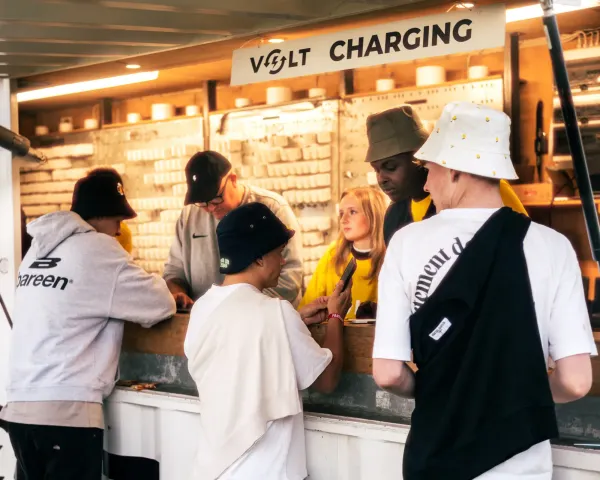
Since most camping fields simply do not wire tent pitches for power, "I'll charge it at the tent" is not a plan, it is a hope. At the big Nordic camping festivals, Volt Charging Service and Volt Self-Service Charging exist for exactly this: swap a powerbank for a fresh one at a staffed point, or take a self-service charger with you for the day. Decide which one your festival runs and where, before you are the one asking a stranger to borrow 10% at 11pm.
5. If you are flying in, your powerbank goes in your carry-on, only
Spare lithium batteries and powerbanks are not allowed in checked luggage on any flight, full stop, and they are capped by capacity even in carry-on. IATA's own traveller guidance puts the limit at 100 Wh without special approval, with a smaller allowance of two spares permitted between 101 and 160 Wh. Pack the powerbank you actually plan to camp with in your hand luggage, not your hold bag, or it will not make the flight at all.
6. Put anything you would hate to lose in a locker, not a tent
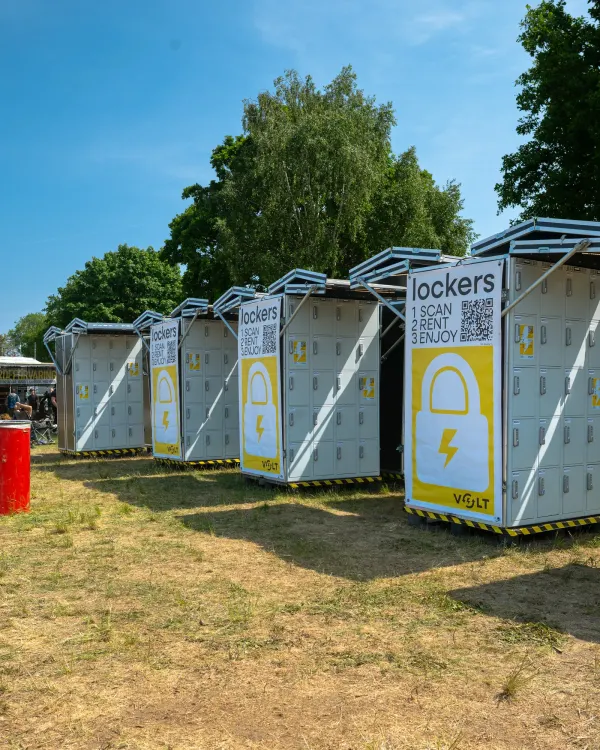
A tent zip is not security, it is a suggestion. Passport, spare cash, a second phone, the good camera, anything you cannot easily replace on site: that belongs in an Event Locker you can open from your phone, not under a sleeping bag in a field full of strangers who are also having a great time. It costs less than replacing what walks off while you are at the front for your favourite set.
7. Learn one landmark near your tent before dark, camps are bigger than you think
Camping fields at the larger Nordic festivals are genuinely large. Roskilde's own site puts its footprint at around 350 football pitches, split across four different camping types (Regular, Special, Community and Volunteer). A flag on a pole is the classic trick, but even a specific flagpole, food stall or toilet block, memorised in daylight, beats trying to retrace your steps by phone torch after your battery has already had a hard day.
8. Do the wristband or ticket exchange the moment it opens
Most Nordic festivals run a separate step before you can actually get in and set up camp: swapping your ticket for a physical wristband, in person, at a specific spot. Way Out West's own FAQ names an exact wristband exchange location, open from a set time, and is explicit that "you can not pick up someone elses wristband." That single queue, done early, is the difference between pitching your tent in daylight and doing it after the good spots are gone.
The short version
Check your festival's own camp-opening date and aim for it. Pack boots before a jacket. Read the camp power rules before you pack anything with a plug, and have a real charging plan for the tent pitch that will not have an outlet. Keep the powerbank in your carry-on if you are flying. Lock up what you cannot afford to lose, learn a landmark before dark, and get your wristband the moment the exchange opens. None of it is complicated. All of it is easier from home than from a queue on day one.
FAQ
Does camping open before the festival's main program starts?
Usually, yes. Roskilde Festival's own site describes a "First Days" period before the Inner Site opens for concerts, with Early Entry onto the campsite ahead of that. Check your specific festival's own page for this year's exact dates.
Can I bring a generator to power my tent?
It depends on the festival and you should check before you pack one. At Tons of Rock's Festival Camp Ekeberg, a power outlet is only included with a motorhome, caravan or bus space ticket, and standard tent pitches are not wired for power at all.
Can I pack my powerbank in checked luggage?
No. IATA's traveller guidance requires spare lithium batteries and powerbanks to travel in carry-on only, capped at 100 Wh without special approval, with a smaller allowance for larger ones.
What do I do if my tent pitch has no power?
That is normal at most camping festivals. Volt Charging Service and Volt Self-Service Charging cover it: a staffed powerbank swap or a self-service charger you keep for the day, depending on what your festival runs.
Is it safe to leave valuables in my tent?
Not really. An Event Locker you open from your phone is a safer, cheaper option than trusting a tent zip in a field full of strangers.