European Green Festival Roadmap 2030: an organiser's guide
YOUROPE's Roadmap targets a 55% emissions cut by 2030. The seven action areas, four levels, how to start, and where power and storage actually fit in.

The European Green Festival Roadmap 2030 is YOUROPE's action plan for cutting festival emissions by 55% before 2030. You meet it by writing a sustainability strategy first, measuring a carbon baseline, then working through seven action areas at whichever of four difficulty levels your event can afford this year. Nothing in it is mandatory, there is no certificate at the end, and you do not have to be a YOUROPE member to use it.
This guide covers what the Roadmap asks for, how to start, and where the unglamorous parts of a site plan sit inside it. Power, storage and the audience's phone matter more than they sound, because several of the Roadmap's own waste actions quietly depend on them.
What the Roadmap actually is
YOUROPE, the European Festival Association, published the Roadmap in 2023 as part of its three-year Future-Fit Festivals project, co-funded by the European Union. It was developed with A Greener Future and Greener Events Norway, and built on the requirements of the European Green Deal alongside the UN Sustainable Development Goals.
The vision is one sentence: European festivals will reach 55% reduction of overall CO2 emissions by 2030. That mirrors the European Green Deal target of cutting net EU greenhouse gas emissions by at least 55% against 1990 levels.
It is a free 41 page PDF. The Roadmap says it is written for festivals and other large open air events far beyond the borders of the EU, so a non-member event outside Europe can still work through it.
One thing to know before you follow the links inside it
The Roadmap points to two companion tools on a domain called Future Festival Tools: a self-assessment questionnaire and a best practice compendium called Green Festival Stories. Neither is reachable any more. Both addresses now redirect to the domain root, which as of July 2026 serves an unrelated sports betting site in Serbian. The domain record was last changed in December 2025.
Checked on 29 July 2026. Do not follow those three links out of the PDF.
The third companion piece is fine. The editable action plan spreadsheet is hosted on yourope.org itself and still downloads, so you can work through every action without the self-assessment.
We also rebuilt the self-assessment, because our readers needed it and waiting was not much of a plan. Every one of the 201 actions from the official spreadsheet is in it, grouped by the seven areas and scored per area, with a not applicable option so an event without a campsite is not marked down for the camping actions. It runs in your browser. No account, no email, nothing collected from your answers. YOUROPE is welcome to take it.
The seven action areas
| Action area | What it covers | Share of global GHG cited |
|---|---|---|
| Strategy | Managing sustainability actions, finance, communications | No level assigned, every festival starts here |
| Energy | Measuring and minimising energy use, shifting to sustainable sources | Energy generation 34% |
| Materials & Waste | Purchasing decisions, waste management, circular approaches | Industrial processes 24% |
| Food & Beverage | Emissions from food and drink, supply chain, waste prevention | Agriculture, forestry and land use 22% |
| Travel & Transport | Low carbon travel to, from and around the site | Transport 15% |
| Water | Water usage, wastewater treatment, protecting water sources | Not given |
| Community & Biodiversity | Local community relationships, habitats, site protection | Not given |
The percentages come from the IPCC Sixth Assessment Report, cited by the Roadmap in each section opener.
The four levels
Every action outside Strategy carries a level: Basic, Moderate, Ambitious or Challenging. Levels are set on three parameters: how much impact the action removes, how much awareness it raises, and how hard it is to implement with real budgets and real staff.
The timeline expects Basic actions first and Challenging actions last, with strategy reviews along the way to 2030. Strategy actions carry no level at all, because the Roadmap treats them as the foundation everything else needs.
How to start
The Roadmap is explicit about the order.
- Write the strategy. Set the scope, a vision, a purpose and goals. Find a reasonable level of ambition and prioritise specific areas.
- Measure a baseline. Use the GHG Protocol. Emissions equal activity data multiplied by an emission factor, summed across Scope 1, 2 and 3.
- Pick KPIs you can collect. The Roadmap's own examples are energy consumption, waste to landfill reduction, recycling rates, reduction in car use, increase in public transport, and water usage.
- Choose a level per area. You do not have to run the same level everywhere.
- Review, then tell people. The Roadmap asks festivals to teach what they know at conferences, in workshops and in interviews, including the things that did not work.
The action plan spreadsheet also has a Responsibility column that the Roadmap never tells you how to fill. We sorted all 201 actions by the department that owns the work, and the short version is that your production and site team carries 76 of them while your sustainability lead carries 23.
On scopes, the Roadmap's own table is worth copying into your spreadsheet. Fuel generators and owned vehicles are Scope 1. Mains power and electric vehicles are Scope 2. Audience travel, purchased materials, hired technology and installations, supplier services and waste disposal are Scope 3.
Where charging and storage sit in the Roadmap
The Roadmap has no chapter on charging or storage. It does not need one. Those services show up inside four of the seven areas, usually as something the Roadmap has already asked you to do.
Materials & Waste asks you to rent and share electronics
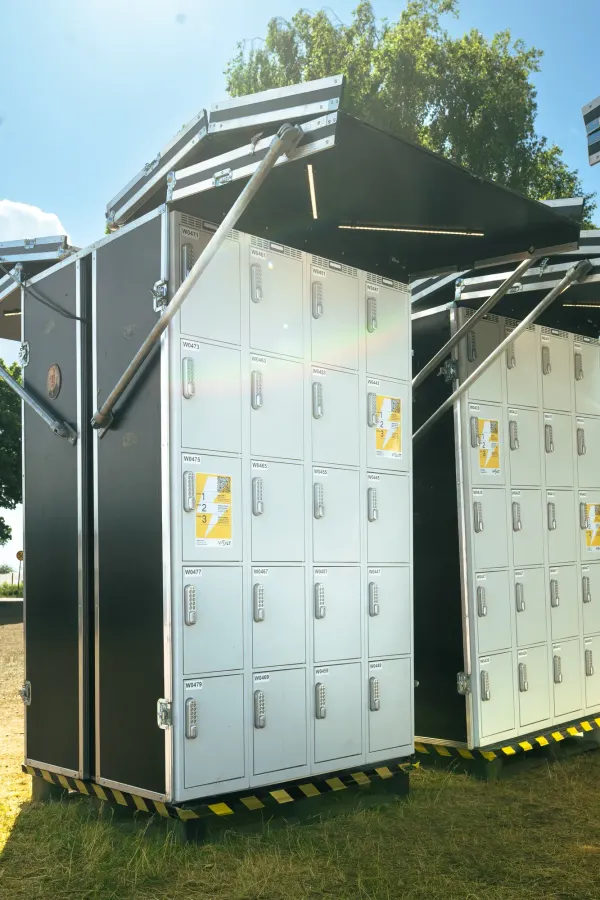
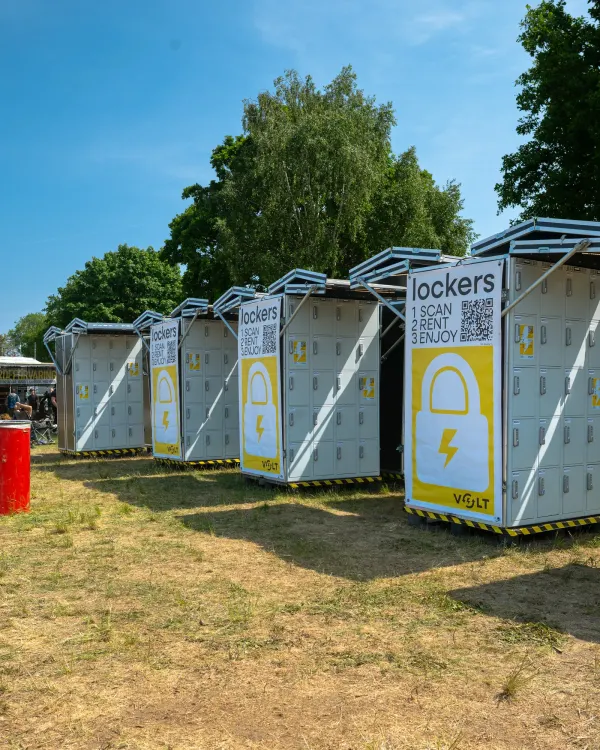
One action reads: reuse, share, rent or donate material to maximise its use, listing stage equipment, fencing, banners, signage, tents and electronic material. A shared powerbank fleet is that action applied to consumer electronics. One fleet serves the crowd instead of thousands of individually bought chargers, and the same fleet moves to the next event when yours ends. Volt has run that model since 2012 and now operates at over 120 festivals & events across six countries.
Energy asks you to cut e-waste and treat batteries as hazardous
The WEEE section asks festivals to extend the life of electronics, route working equipment into reuse schemes, and handle batteries and electronic equipment as hazardous waste rather than general waste. Materials & Waste separately asks for dedicated areas for safe storage of hazardous wastes, naming WEEE, lightbulbs and batteries.
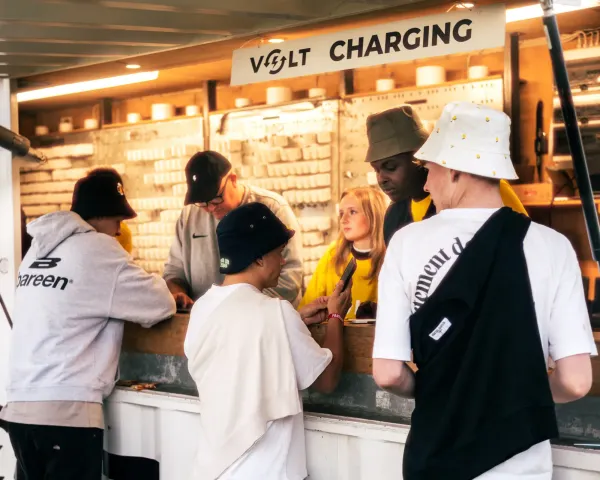
Cheap powerbanks bought at a service station and abandoned in a campsite are that waste stream. Rental hardware with a refundable deposit has a reason to come back: at Volt a Volt-Charger carries a 150 kr deposit and a self-service charger with integrated cable 175 kr, refunded to the same card after return. More on how the two charging services run on site.
Materials & Waste asks you to go paperless, which assumes a live phone
This is the connection most sustainability plans miss.
The Roadmap asks you to communicate electronically with performers and audiences, covering tickets and event programmes. It asks for accreditation, ticketing, accounting and invoicing to be done electronically. It asks you to avoid overproduction of wristbands, badges and lanyards.
Digital ticketing, digital programmes, cashless bars and app based site maps all remove printed material from your site. They also move your entire operation onto a device with a battery in it. When phones die at scale you get gate friction, longer support queues, and pressure to reinstate the printed fallback you just removed. Power is the dependency underneath the paperless plan rather than a convenience sitting next to it.
Travel & Transport asks you to move people by phone
The Roadmap asks you to provide clear site location information using map apps so people avoid unnecessary travel and do not get lost. It suggests free or reduced public transport tickets bundled into admission, shuttle services from stations, and carpooling organised through social media.
All of that arrives on a screen. Someone whose phone died at 22:00 does not catch the last train home, they take whichever option works without an app.
Strategy asks for KPIs, dashboards and funding
Two Strategy actions land here. One asks you to identify KPIs and gives measuring energy consumption as the first example. Another asks for progress reports, dashboards or other visual tools to communicate progress. Metered service infrastructure is where those numbers come from, and Volt builds its own locker management and real time charging analytics rather than buying them in.
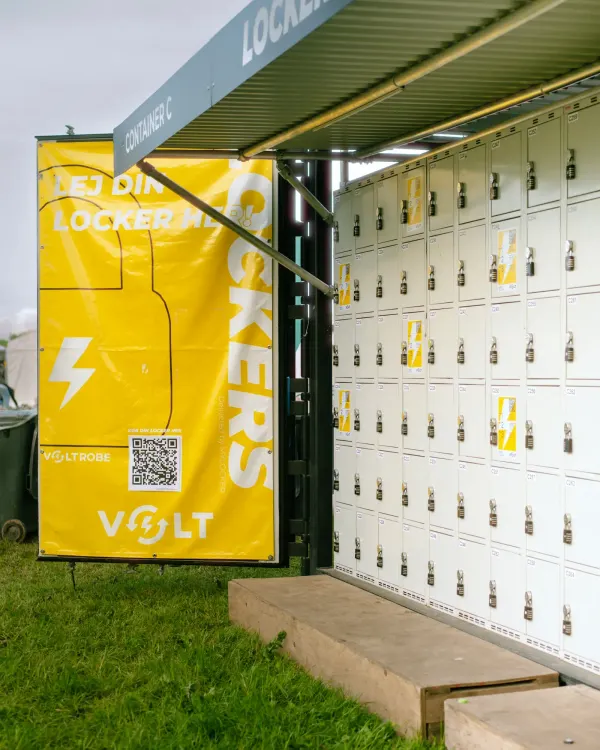
The Finance section suggests green fees and reinvesting revenue into sustainability management. Rental services can run on revenue share instead of appearing as a cost line. At GRØN, 25 DKK from every Event Locker booking goes to Muskelsvindfonden, which is the same mechanism aimed at a charity instead of a budget.
Two small ones worth catching
Materials & Waste asks you to avoid date marking on banners and signage so they can be reused, and to plan long term partner relationships for multi-year assets. If you are putting sponsor branding on lockers or branded sleeves, leave the year off and you get several seasons from the same artwork.
Community & Biodiversity asks you to advertise temporary jobs locally first and recruit staff from neighbouring communities. Suppliers who recruit and run their own volunteer crews can be pointed at that target rather than working around it.
What charging and storage will not do for you
Worth being straight about, because a sustainability report that overstates small wins is easy to pull apart.
It will not move your biggest number. The Roadmap's cited IPCC figures put energy generation at 34%, food and land use at 22% and transport at 15%. Chargers and lockers are small next to a diesel generator fleet or 30,000 people driving to your gate. Fix those first.
Rented hardware is only as clean as your site power. Volt does not publish a verified renewable energy claim for its charging fleet, and you should not write one into your report on its behalf. The fleet draws from whatever the site supplies. On a green tariff or on-site renewables the charging load sits inside that, on diesel it sits inside that instead. Ask every service supplier on your site what they are plugged into and account for it accordingly.
Sharing hardware does not erase manufacturing emissions. It changes how many devices get made per festival goer. There is no clean published figure for that at festival scale, so leave the number out rather than inventing one.
No supplier is required. Nothing in the Roadmap names a vendor. A festival running charging and storage in-house to a good standard scores exactly the same.
Organiser checklist
- Download the Roadmap and the editable action plan spreadsheet, and skip the Future Festival Tools links inside the PDF
- Work through the 201 action self-assessment to find your starting position per area
- Write the strategy before buying anything
- Assign an owner to every action area, using the department split as a starting point
- Set a baseline using the GHG Protocol scopes
- Pick KPIs you can actually collect this season
- Ask every supplier what their power source is and whether their hardware leaves with them
- Check that your paperless plan survives a flat battery
- Leave the year off branded assets so they run again next season
- Review annually and publish what you learn
FAQ
Do you need to be a YOUROPE member to use the Roadmap?
No. The Roadmap is a free public PDF and the Roadmap itself says it is relevant to festivals and large open air events beyond the EU. Membership gets you the network, the summit and the working groups, not access to the document.
Is the Roadmap a certification?
No. It is a framework with no assessor and no certificate. The Strategy section points at the certification routes instead: AGF Certification, ISO 20121, ISO 14001 and EMAS. All of those require a strategy or action plan, which is why the Roadmap puts Strategy first.
Is the Future Festival Tools self-assessment still available?
No. Both the self-assessment and the Green Festival Stories compendium linked from the Roadmap now redirect to a domain serving unrelated sports betting content, checked 29 July 2026. Use the editable action plan spreadsheet on yourope.org instead, or our rebuilt self-assessment, which carries all 201 actions from that spreadsheet.
Where should a festival start?
Strategy. It is the only area with no difficulty level attached, because the Roadmap expects every festival to complete it regardless of size or budget. Set the scope, measure a baseline, choose KPIs.
Which emissions scope do festival charging and lockers fall into?
Mains power is Scope 2. Fuel generators are Scope 1. Services run on your site by a supplier fall under Scope 3, alongside hired technology and installations. The Roadmap has the full table.
Does offering rented powerbanks and Event Lockers count towards the Roadmap?
It maps to the Materials & Waste action on reusing, sharing and renting material including electronic material, and to the Energy actions on e-waste and WEEE. It is a real action in the plan, not a headline emissions lever, so record it as what it is.
What is the 55% measured against?
The Roadmap's vision is aligned with the European Green Deal, which targets at least 55% below 1990 levels by 2030. Your own festival baseline is whatever year you first measure properly, which is why the Roadmap asks you to set one early.
Working it through on a real site
Volt runs charging and Event Lockers at over 120 festivals & events across Denmark, Norway, Sweden, Finland, the Netherlands and Belgium, including four YOUROPE member festivals: Roskilde, Smukfest, Provinssi and Ruisrock.
If you are mapping Roadmap actions to your own site plan and want to know what the service layer looks like in practice, including what to ask a supplier about power, hardware return rates and revenue share, talk to us at hello@getvolt.dk.