20 Green Festival Roadmap Actions This Season
See the 20 actions from Yourope's 201-action Green Festival Roadmap 2030 that need no budget or new supplier, so you can start before this season ends.

20 Green Festival Roadmap actions you can still do before this season ends
You do not need a new budget line or a new supplier to make progress on Yourope's European Green Festival Roadmap 2030. Out of its 201 actions across 36 groups, we pulled the 20 that any festival still running events this season can start this week: no capex, no procurement cycle, no contract renegotiation. Just changes to what you measure, communicate and ask your existing team and suppliers to do differently.
This is Volt's own shortlist, built by reading all 201 actions in Yourope's roadmap and filtering for one thing: can an operations team do this before the last show of the season, using the people and kit already on site? It is not an official Yourope product, and Yourope has not reviewed or endorsed this cut. If you want the full picture first, our organiser's guide to the Roadmap covers all seven areas, and who owns which of the 201 actions breaks the full list down by department.
Why "no capex, no new supplier" matters mid-season
Most sustainability advice assumes you are planning next year's build: new toilets, new generators, a different caterer. That is real work, but it cannot happen between now and your next event date. The 20 actions below are different. They are process, measurement and communication changes: things a production manager, a sustainability lead or a comms person can decide and start today, using the suppliers, staff and volunteers already contracted for this season.
The 20 quick wins, grouped by Roadmap area
Strategy (3 actions)
- Measure where you stand today. Before you can claim progress, you need a baseline. Pull whatever energy, waste and water numbers you already have from this event or the last one and write them down in one place. That single document becomes your reference point for every future claim.
- Turn your numbers into a one-page dashboard. A spreadsheet with a chart works fine. The Roadmap's own guidance is that progress needs to be "easy to see at a glance," for your own team as much as for anyone external.
- Publish what is actually working. A short post on your site or socials about one concrete change (a waste sorting result, a transport shift) costs nothing and is the kind of specific, dated claim that holds up better than a vague sustainability statement.
Energy (3 actions)
- Build a baseline energy figure per area. Before you can cut energy use, you need to know where it is going: production offices, stages, food court, camping. Check consumption regularly enough to spot the outliers.
- Switch off what nobody is using. Lights in empty production offices, outdoor lighting in zones that are closed for the day. It is a walk-through, not a purchase order.
- Kill heating and cooling in unoccupied rooms. Staff offices, dressing rooms, anywhere with a thermostat and nobody in the room. Same logic, same zero cost.
Materials and waste (4 actions)
- Print only what you need. Stop overordering wristbands, badges, lanyards and merch "just in case," and default to double-sided printing for anything that still goes to paper.
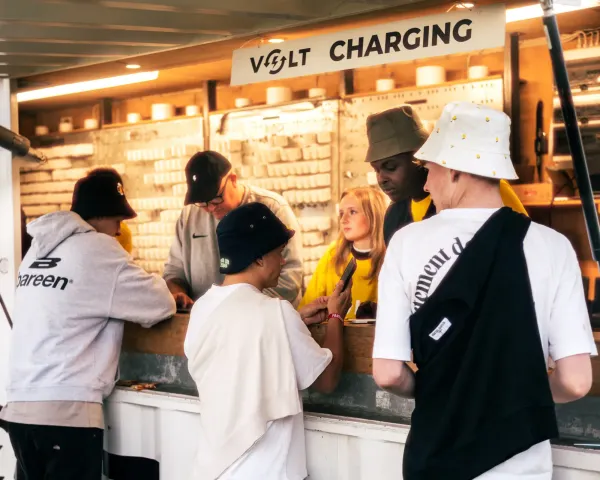
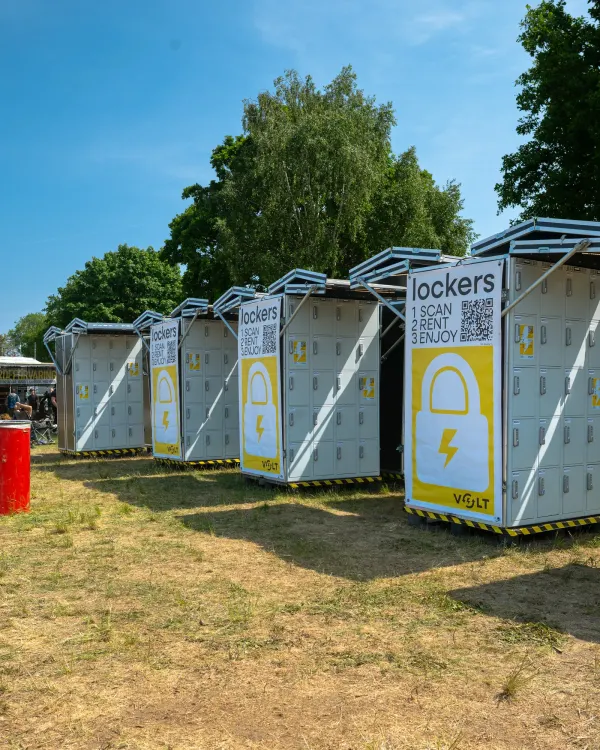
- Go digital with the paperwork you control. Performer registration and schedules, audience tickets and programme information: send it by email instead of printing it. This is also where a working phone stops being optional for your festival goers. If your event runs Volt's charging or Event Lockers, the access codes already arrive by email and SMS, so a phone with charge is doing double duty: it is how people get into their locker and how they read the programme you just stopped printing.
- Skip dating your signage and banners. If a banner or sign does not need a year printed on it, leave it off. That is the difference between a one-event asset and something you can reuse next season for free.
- Actually communicate your recycling setup. A waste system nobody understands does not get used correctly. Tell crew, traders and audience where things go, on your site map, at bin stations, in the pre-event email. Free to do, and it is the single biggest lever on how clean your sorted streams come out.
Food and beverage (3 actions)
- Compare what you bought against what customers actually ordered. Most catering waste shows up right here. You already have the purchase orders and the till data; put them side by side.
- Right-size portions and drop garnishes nobody eats. A menu tweak, not a new supplier. Ask your existing caterers to adjust portion sizes and cut the decorative extras that end up in the bin.
- Nudge buffet behaviour. If any part of your event runs buffet-style service, a simple sign asking people to take only what they will finish measurably cuts plate waste.
Travel and transport (3 actions)
- Run a travel survey. Ask visitors, staff and performers how they got to the event and how far they travelled. It costs a form and gives you the one number every future transport decision should be based on.
- Push transport options through channels you already own. Your website, your socials, your pre-event emails: use them to point people at public transport and away from driving, before the next show weekend.
- Give people better directions. Clear location info through map apps and your own site means fewer people driving in circles, idling, and burning fuel looking for the entrance.
Water (2 actions)
- Tell people to turn taps off. Simple signage near taps and standpipes about conserving water. Zero cost, and it works because most water waste at events is not a leak, it is a habit.
- Check your distribution system for leaks. A walk of the pipework and standpipes before your next event date catches the failures that would otherwise run all weekend unnoticed.
Community and biodiversity (2 actions)
- Ask your neighbours how it is actually going. A short feedback request to local residents costs nothing and surfaces problems (noise, traffic, litter drift) while you can still fix them this season.
- Set up one complaints channel with a named owner. An email address and a person who checks it daily. If neighbours cannot reach you easily, small issues turn into formal complaints.
What this list deliberately leaves out
None of the 181 remaining Roadmap actions are less important. They are just not quick wins in the sense this piece means: buying LED fixtures, connecting to a green energy tariff, switching to reusable serveware, running a biodiversity survey, or getting AGF, ISO 20121, ISO 14001 or EMAS certified all take budget, lead time, or a new supplier relationship. Those belong in next season's planning cycle, not this week's to-do list. Our full breakdown of who owns which of the 201 actions covers the rest, sorted by department.
FAQ
Is this an official Yourope shortlist?
No. Yourope's European Green Festival Roadmap 2030 is the source framework, published at yourope.org, and the 201 actions and 36 group headings are Yourope's structure. This specific 20-item "quick win" cut is Volt's own curation for festivals still mid-season, not a Yourope product, and Yourope has not reviewed it.
Can we really do all 20 with zero budget?
All 20 avoid new capital spend and a new supplier contract. A few, like printing less or adding signage, might cost a small amount for paper or a sign, but nothing that needs a procurement process or a new vendor relationship.
Where do the other 181 actions live?
In Yourope's full Roadmap. Our organiser's guide covers all seven areas end to end, and our free self-assessment tool scores your festival against the full 201.
What if we want to check our own progress against the Roadmap?
Use the Green Festival Roadmap 2030 self-assessment, a free interactive tool built on the same 201-action structure. It scores you area by area and flags where the quick wins above would move the needle most.
Does Volt sell any of these sustainability actions as a product?
No. Volt runs Event Lockers and charging services at festivals. The only overlap on this list is action 8: going digital with tickets and programmes assumes festival goers have a charged phone, and that is exactly what Volt's charging keeps true all weekend. Everything else on this list is independent of anything Volt sells.
Start with the three that cost you nothing today
If you only do three things from this list before your next show: build the baseline dashboard (action 2), tell your crowd where the recycling actually goes (action 10), and set up one named complaints channel for neighbours (action 20). All three are free, all three are done by end of week, and all three give you real numbers and real feedback to build next season's plan on. For the full 201-action picture, run your festival through the self-assessment or read the organiser's guide before you plan next year's build.